
First Flush Diverter or Mechanical Filter? Choosing the Right Rainwater Filter in the UK

If you have been looking at rainwater harvesting, you may have come across the term “first flush”. It sounds logical: the first rain falling on a roof washes away dust, pollen, bird droppings and other accumulated debris, so why not divert that water away and only collect the cleaner rain that follows?
The answer is that first-flush systems can be useful in climates like parts of Australia where they have prolonged antecedent dry periods, rainfall intensity and the amount/type of material accumulated on the roof, but where they work best depends on the climate, the roof and what you intend to do with the water.
Why is first flush so popular in Australia?
First-flush rainwater diversion has become an established part of rainwater harvesting in Australia, where large domestic rainwater tanks are widespread. After a prolonged dry spell, the first rainfall deluge during storms can wash accumulated dust, bird droppings and other material from a roof into the tank in pretty much one fell swoop. This extremely dusty sludge water is held in a separate container (which needs to be emptied from time to time), and then when full, the “cleaner” rainwater goes to a storage tank. Australian guidance recommends first-flush devices, particularly where rainwater is being used for drinking and other household purposes. For garden irrigation, however, its main benefit is reducing the amount of sediment entering the tank.
It is a sensible response to those conditions. But that doesn't mean the same approach is automatically the best answer for a British garden.
Does the British climate make a difference?
Yes. The UK doesn't generally have the same pattern of long, hot, dry periods followed by intense rainfall. Rain is spread throughout the year. The Met Office's 1991–2020 UK averages record 159 days a year with at least 1mm of rainfall.
That matters because a first-flush diverter throws away a set amount of water at the beginning of a rainfall event.
Consider a 90 m² roof. Just 1mm of rain produces around 90 litres of runoff. If your first-flush system diverts 20 litres, more than a fifth of that rainfall has gone down the drain before you collect anything. During a smaller shower, the proportion is even greater. And if you have five small rain events in a single day, then you may end up with no collected or stored rainfall.
For a UK gardener trying to make the most of available rainfall, repeatedly discarding the first few litres isn't necessarily the best trade-off.
What about leaves, moss and bird droppings?
Of course, British roofs still get dirty. Moss, leaves, insects, dust and bird droppings can all find their way into gutters.
But there is another way of dealing with that problem: filter the physical debris rather than automatically throwing away a fixed quantity of rainwater. And filter all of that debris all of the time.
A good example of a rainwater harvesting filter for the UK climate is the 3P Filter Collector. It uses a removable stainless-steel filter to screen debris from the downpipe before the water enters storage. The unit is specified for roof areas up to 90 m², making it particularly relevant to a typical domestic roof.
The filter can be removed and cleaned (when necessary), while the system can continue diverting filtered rainwater to the tank. It is a pre-filter, not a drinking-water purification system, and is for non-potable uses such as watering the garden.
The 3P Filter Collector also works as a diverter and overflow. It therefore also diverts the filtered rainwater to your storage tank, and when the tank is full, when the filter is fitted correctly, the excess water continues to overflow down your downpipe.
So, what is the right answer for Filtering water for Rainwater Harvesting Systems in the UK?
There isn't one answer for every roof, intended use or storage size.
UK agricultural guidance currently recognises several approaches to pre-treating harvested rainwater before it is stored, including first-flush diverters, mechanical downpipe filters and two-stage pre-filtration systems.
These are not interchangeable technologies: first-flush systems discard an initial volume of runoff, whereas mechanical and two-stage filters remove debris from the water as it passes through. Which approach makes sense depends on the roof, rainfall pattern and intended use. The 2026 FETF specification for crop irrigation actually requires two-stage pre-filtration (now closed).
Summary of differences between different Rainwater Harvesting Filter Types:
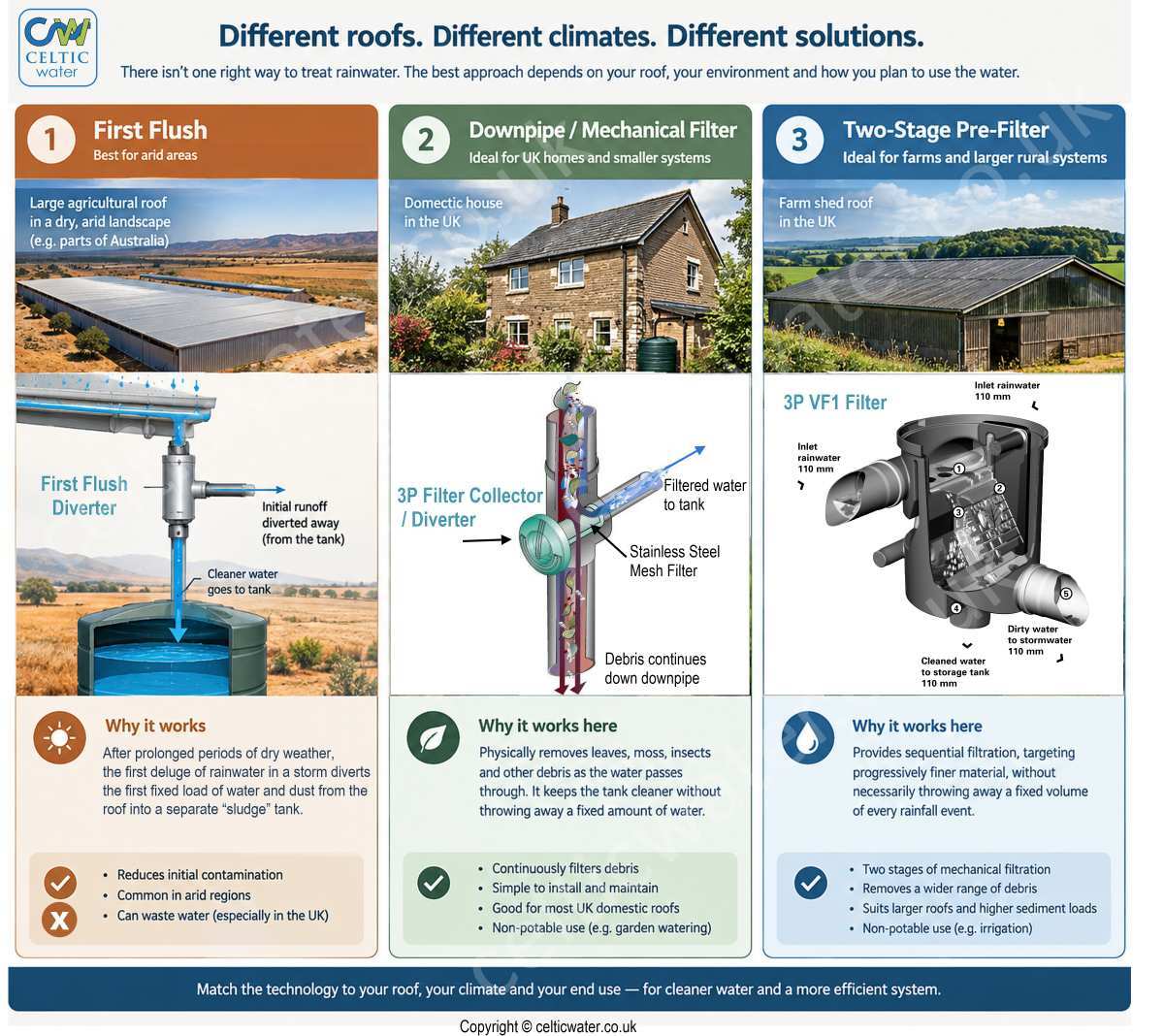
- First flush: deliberately diverts an initial quantity of runoff away from the tank, based on the assumption that the beginning of a rainfall event carries a higher contaminant load - often used in arid areas like parts of Australia.
- Downpipe/mechanical filter: physically removes debris from the water as it passes through - like the 3P Filter Collector.
- Two-stage pre-filter: provides sequential mechanical filtration, typically targeting progressively finer material, without necessarily throwing away a fixed volume of every rainfall event – like the 3P VF1 Filter and Twin Filters.
For a typical domestic garden, however, the important question is not “What technology is popular somewhere else?” but:
What is on my roof, what is falling on it, how often does it rain, and what am I going to use the water for?
For most UK homes collecting rainwater for garden irrigation and other non-potable uses, continuously removing roof debris with an accessible mechanical filter like the 3P Filter Collector is a great choice.
Good rainwater harvesting isn't about copying a system from another climate. It's about choosing the right treatment for the roof you actually have and the water you actually need.
Further Information
Confused about which rainwater harvesting filter is best for your system in the UK? Contact us to speak or email one of our technical advisors. We have experience in domestic and agricultural rainwater harvesting systems.
Newest Guide & Blog Updates
First Flush Diverter or Mechanical Filter? Choosing the Right Rainwater Filter in the UK
If you have been looking at rainwater harvesting, you may have come across the term “first flush”. I...
How to Connect a Hosepipe to a Water Butt Tap Using a Click-Connect Fitting
Connecting a garden hosepipe to the metal tap supplied with our decorative water butts is straightfo...
Why the 1500L Utility Tank Is Gaining Attention in Commercial Fire Water and Rainwater Harvesting Projects
The Rise of the 1500 Litre Fire Sprinkler Tank for Basement and Above-ground Installations As commer...
Earth Day 2026: Small Actions, Shared Power
Earth Day 2026 is centred on a powerful idea: Our Power, Our Planet. It’s about recognising that rea...

Award-Winning Float Switch for Water Level Control | MAC3 Key Green
We’re proud to share that the MAC3 Key Green float switch has been recognised as a winner at the pre...
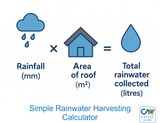
Simple Rainwater Harvesting Calculator UK
How much rainfall does it take to fill a water butt from a downpipe? Water is a finite resource, and...